

Alysoun McLaughlin Testifies on How Election Officials Prepare for Disruptions

As voting gets underway for the 2026 general election, Alysoun McLaughlin told members of Congress that election officials are preparing for the unexpected—and know how to respond when problems arise.
Alysoun, director of the Election Resilience Lab at the University of Maryland’s Center for Democracy and Civic Engagement (CDCE), was invited by Rep. Jamie Raskin’s staff to testify at “Protecting Democracy: Defending the Right to Vote,” a Sept. 22 spotlight hearing held by Democrats on the House Judiciary Committee.
She testified alongside Michael Waldman, president and CEO of the Brennan Center for Justice at NYU School of Law, and Jessica Jones Capparell, director of government affairs at the League of Women Voters of the United States. Rep. Glenn Ivey, who participated in the hearing, also acknowledged the work being done at UMD.
Asked how election officials would respond to extraordinary circumstances, Alysoun pointed to the responsibilities and procedures already guiding their work.
“They will follow the law. They will maintain custody and control of election materials. They will follow existing contingency plans.”
Drawing on more than 25 years of experience in election administration and policy, Alysoun addressed situations ranging from power outages and mail disruptions to cyberattacks, threats at polling places and legal disputes. She explained how election officials prepare through contingency plans, practice exercises and relationships with local partners.
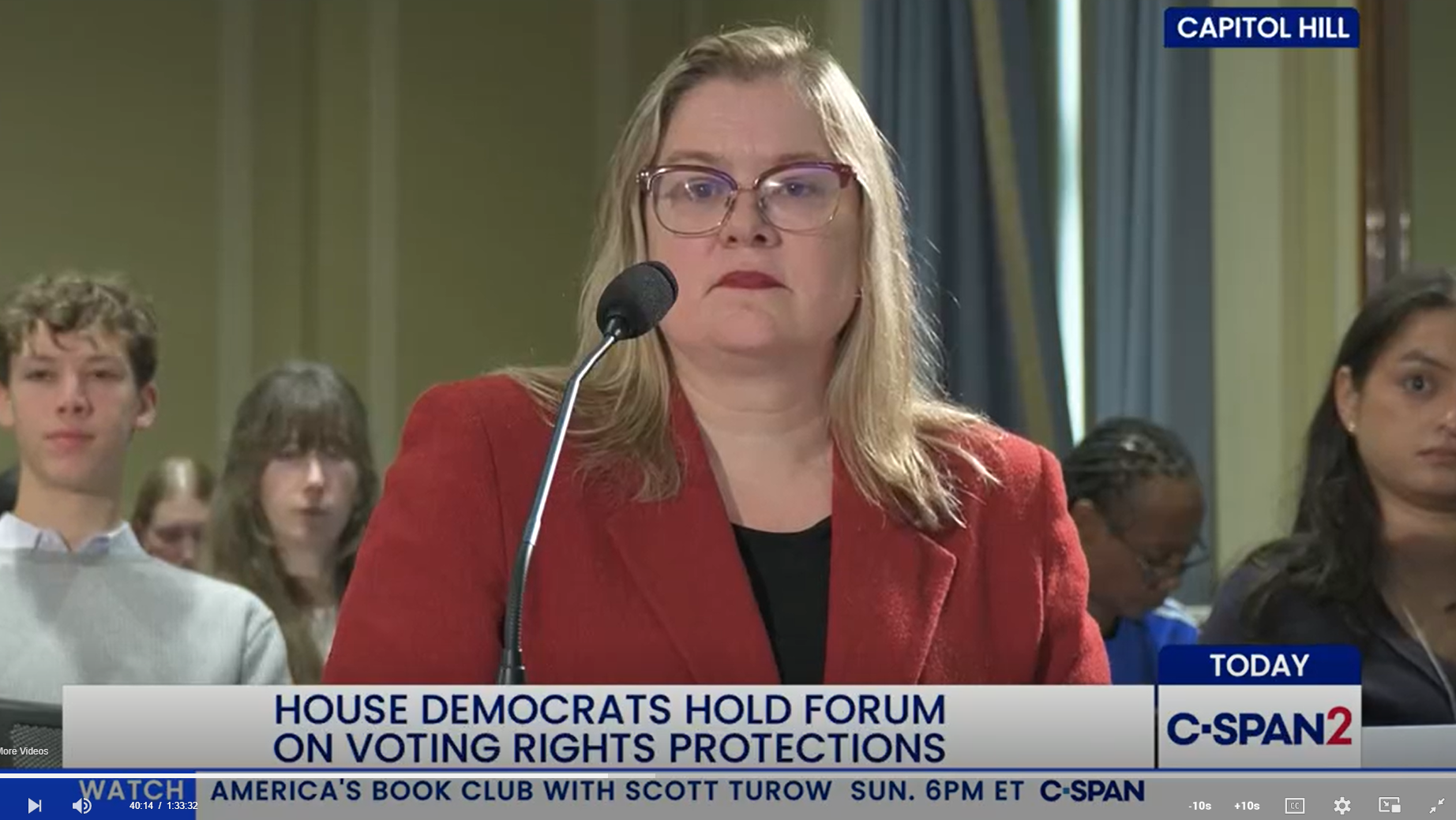
Alysoun McLaughlin prepares to testify at a House Democrats’ forum on voting rights protections Sept. 22. (Image: C-SPAN)
Her testimony also drew on the Election Resilience Lab’s nationwide study of election staffing, described in its report The HR of Democracy: Understanding the Election Workforce.
“Extraordinary events do occur,” Alysoun said in her written testimony. “And with each new challenge, election officials have proven that they will rise to the occasion, not by acting alone but by following the law, relying on established procedures, and turning to their relationships and systems that they built long before a crisis occurs.”
Watch the full hearing on C-SPAN
Published on Thu, 09/24/2026 - 11:46