

Beyond the Numbers: Lexi Sens Examines Conflict and Humanitarian Aid in East Africa
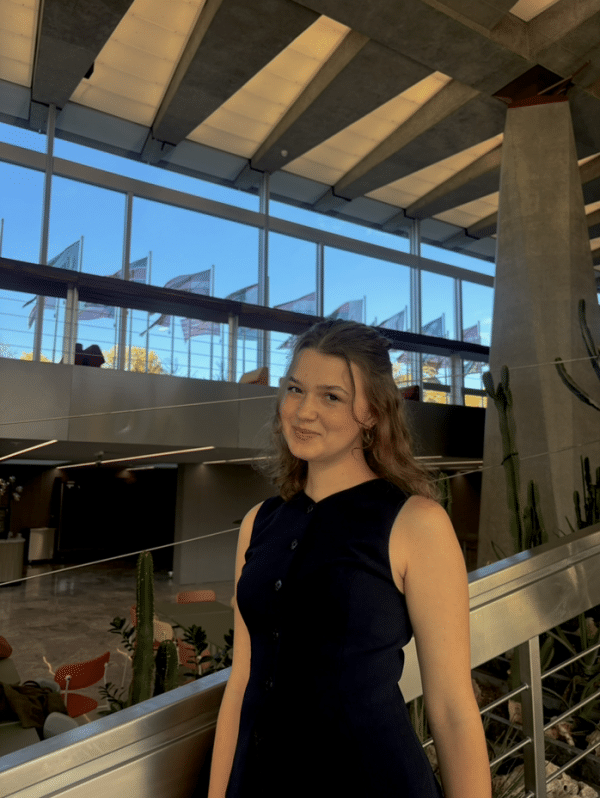
When Lexi Sens first became interested in international relations, she was fascinated by maps and the places they represented. As she learned more, however, those places became more than borders on a page.
“They’re real places with real people and real issues,” Lexi said.
Now a junior at the University of Maryland studying international relations and global health, Lexi is examining how conflict affects humanitarian aid efforts in Sudan and Ethiopia.
Her research centers on a difficult question: Why does humanitarian assistance often struggle to reach people experiencing conflict, displacement, and food insecurity, even when billions of dollars are committed to relief efforts?
Lexi’s interest in the region began during her senior year of high school, when a guest speaker discussed famine in Sudan. At the time, she had planned to pursue engineering and was interested in working on clean-water projects. The presentation introduced her to another way of studying the problems she cared about, one that connected politics, public health, and humanitarian action.
At UMD, that interest developed into a research project examining why humanitarian interventions succeed in some areas but fall short in others. Rather than looking at aid only through funding levels or the number of people reached, Lexi wanted to understand the political and institutional conditions that shape how assistance is delivered.
As part of the project, she interviewed seven humanitarian practitioners and regional experts. Their experiences helped her understand the layers of coordination required to deliver aid in a conflict zone.
Humanitarian organizations must often work with national and local governments, security forces, community leaders, and other organizations. Each group may have different priorities, responsibilities, and concerns. Governments must also consider their sovereignty and legitimacy when deciding how international organizations can operate within their borders.
The interviews helped Lexi better understand how partnerships between international organizations, local governments, and communities shape the delivery of aid. She examined the mechanisms behind those relationships and how collaboration can help organizations respond more effectively to local needs.
“We have to think about ourselves as collaborators,” Lexi said. “If you only see yourself as going in to help, you’re not necessarily going to make progress.”
The project also led Lexi to explore how history continues to shape present-day conflicts. While comparing Sudan and Ethiopia, she examined the role of ethnic divisions, colonial borders, and regional politics. She found these conflicts did not emerge in isolation. Understanding how they developed requires looking at the historical decisions and political structures that preceded them.
Completing the project required Lexi to develop her own research process. She began by reviewing scholarship her advisor recommended and used the sources cited in those works to deepen her understanding of the topic. As her knowledge grew, she narrowed her initial idea into a more specific research question and developed a consistent set of interview questions.
After completing the interviews, Lexi organized the responses into four themes. She compared areas of agreement, identified differences in their experiences, and connected those findings to existing research.
The comparative portion of the project was especially challenging. Reliable information from conflict zones can be incomplete or unavailable, and the conflicts in Sudan and Ethiopia have unfolded under different political conditions and timelines. Lexi had to account for those differences without treating the two cases as identical.
Presenting her work at an undergraduate research conference helped her bring the project's different pieces together. Explaining the research to people without extensive knowledge of the region challenged her to communicate complex ideas clearly and concisely. It also allowed her to respond to questions and recognize how much knowledge she had gained throughout the process.
Lexi is continuing to build on the project while studying abroad in Geneva, Switzerland, through a global health and development program. There, she is learning about the history of humanitarian action and hearing directly from people working in international organizations.
For an independent study project, she is researching health outcomes in regions with recent or limited international recognition. She is also exploring a senior thesis focused on the relationship between colonialism, developing economies, and conflict.
Although her next research question is still taking shape, Lexi’s broader direction is becoming clearer. She plans to continue examining the intersection of policy, diplomacy, and humanitarian action, focusing on how institutions can respond more effectively to people living through conflict.
Published on Tue, 11/17/2026 - 14:05