

CDCE, BSOS, and MDI Lead Forum on Modern Movements Expanding the Right to Vote
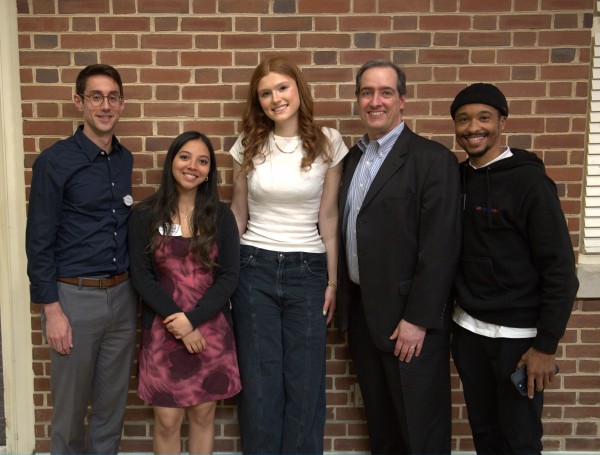
Experts from the University of Maryland’s Center for Democracy and Civic Engagement (CDCE) and Maryland Democracy Initiative brought together faculty, scholars, advocates, students, and community members on Thursday, April 9 for “An Exploration of Modern American Suffrage Movements,” a forum focused on how voting rights continue to evolve in the United States.
Hosted in partnership with the First Year Book Initiative, and as part of the College of Behavioral and Social Sciences’ inaugural BSOS Community Forum series, the speakers highlighted research practice partnerships led by BSOS faculty to explore three active movements to expand voter eligibility in the United States: restoring voting rights for people with felony convictions, extending local voting rights for non-citizen residents, and lowering the voting age to 16. The forum built on a series of workshops organized throughout the 2025-2026 academic year by CCDE Chief Strategist Sam Novey to cultivate connections between UMD scholars and community partners working to strengthen democracy.
Opening the forum, Susan Rivera, Dean of the College of Behavioral and Social Sciences (BSOS), explained why these conversations matter now more than ever, saying, “There are plenty of disagreements on how to interpret the Constitution and its amendments. But the topic that will be discussed today is the greatest tool we have for shaping the future of our country, and that’s our vote.”
Restoring Voting Rights for People with Felony Convictions
The first discussion of the forum examined the nationwide movement to restore voting rights for people with felony convictions.
Rob Stewart, an assistant professor in UMD’s Department of Criminology and Criminal Justice, traced the history of felony disenfranchisement, explaining how many of these laws gained momentum after the Civil War and were used in many Southern states to limit Black political participation. But he also emphasized that the story today is not only one of restriction, but of meaningful expansion in recent years.
Stewart noted that an estimated 5.9 million Americans were disenfranchised due to felony status in 2016. By the 2024 election, that number had dropped to just over 4 million, a decline of more than 30%. He also pointed to reductions in racial disparities, saying the share of disenfranchised Black adults fell from 8.3% in 2000 to 5.3% today.
“We are no longer looking at a state of democratic contraction,” Stewart said. “We are now looking at a state of democratic expansion.”
Joining him was Nicole Porter, senior director of The Sentencing Project, a national organization focused on sentencing reform, voting rights restoration, and reducing mass incarceration. Porter pointed to Maryland’s leadership in voting access, noting that House Bill 115 passed on April 8 and will automatically register eligible individuals to vote as they exit state prisons beginning in January.
“Our position is that no one should ever lose their right to vote,” Porter said.
Extending Local Voting Rights for Non-citizen Residents
The second discussion explored the growing movement allowing non-citizen residents to vote in local elections.
Janelle Wong, a professor in the UMD Departments of Government and Politics (GVPT) and American Studies, and a CDCE Faculty Fellow, presented research conducted with the immigrant advocacy organization We Are CASA, in Maryland communities such as Hyattsville and Beltsville. Researchers interviewed residents in municipalities where non-citizens can vote in municipal elections and compared them with nearby communities where they cannot.
Wong said one of the clearest findings was that many immigrant residents remain eager to participate civically despite fear and uncertainty.
“I want to emphasize the terror and fear we feel,” one respondent shared during the study. Another said, “If I can do it [vote in local elections], I will.”
Wong also emphasized the importance of trusted community institutions, noting that interview participants consistently pointed to We Are CASA as a key source of support, education, and civic engagement.
Community advocates from We Are CASA, Viviana Lozano and Lidia Rivas, and GVPT alum Amena Talajawala, who served as a research assistant for Wong, discussed ongoing campaigns in Maryland municipalities where residents are fighting either to gain or preserve local voting rights. They described communities where immigrant residents have lived for 10, 15, or even 30 years and want a voice in decisions that directly affect schools, safety, and neighborhood life.
Lowering the Voting Age to 16
The final discussion focused on efforts to lower the voting age to 16 in local elections.
Jared McDonald, a professor at the University of Mary Washington, CDCE Faculty Fellow, and a graduate of UMD’s GVPT Ph.D. program, shared research examining how the public responds to Vote16 proposals. His team found that many opinions are not firmly set and can shift depending on the messages people hear last—suggesting that awareness and education remain critical.
LaJuan Allen, executive director of Vote16USA, a national campaign that supports youth-led efforts to lower the voting age on the local level, said 15 cities nationwide currently allow 16- and 17-year-olds to vote in some elections, with 10 of those communities located in Maryland.
“Maryland is leading the way nationally,” Allen said.
Anya Kleinman, co-founder of Vote16MD and a senior at Richard Montgomery High School, shared that advocates recently introduced legislation in the Maryland General Assembly to lower the Board of Education voting age in Howard County and have expanded organizing efforts to more than six counties statewide.
Throughout the afternoon, speakers returned to a common theme that Sam Novey emphasized: voting rights are not permanent or settled. They continue to be debated, expanded, challenged, and reshaped through research, organizing, legislation, and public engagement.
Whether discussing reentry after incarceration, immigrant participation in local government, or youth civic voice, the forum showed that democracy is shaped in classrooms, city councils, statehouses, and communities where people organize for change.
As the event closed and attendees continued conversations over food and fellowship, one message was clear: Maryland remains at the center of some of the nation’s most important conversations about who gets a voice in democracy.
Published on Wed, 04/15/2026 - 11:43