

UMD Moot Court Team Wins Multiple Top Spots in National Written Brief Competition
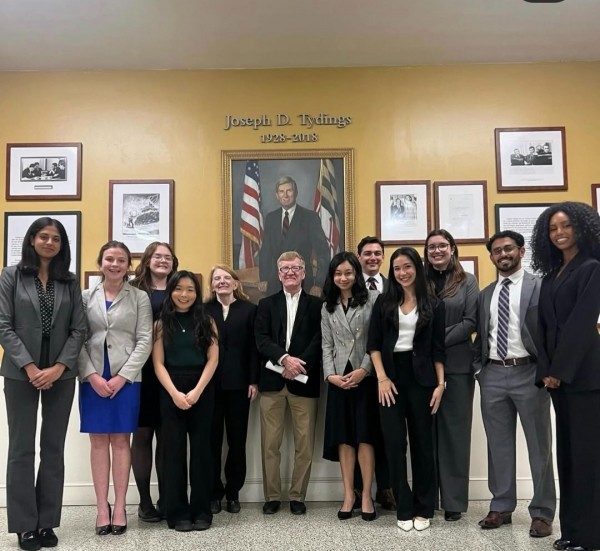
The University of Maryland Department of Government and Politics’ Moot Court Team took home multiple awards from the American Moot Court Association’s (AMCA) national Written Brief Competition, including sweeping the top three spots in the petitioner portion of the competition.
The Written Brief Competition challenges undergraduate students to draft a roughly 30-page appellate-level argument based on a closed, hypothetical U.S. Supreme Court case. The top 15 briefs on both the petitioner side and respondent side receive national awards, leaving 30 total awards up for grabs. Five of the UMD Moot Court Team’s eight teams placed nationally, effectively securing one-sixth of the available awards.
On the petitioner side, Tara Davoodi and Annalise Bachmann earned first place, Claire Bandy and Benjamin Nathan placed second, and John Paul Ciminera and David Stanco placed third. During the late-February awards announcement, AMCA President Michael Walsh said that such a sweep may be unprecedented in the competition’s history.
On the respondent side, Maja Durkovic and Louisa Sanford placed third, and Samantha Sirianni-Chaitram and Zachary White earned eighth.
This year’s case presented two constitutional questions: a 14th Amendment issue modeled after Students for Fair Admissions v. Harvard, reimagined as a gender-based affirmative action case, and a First Amendment question examining whether a professor’s speech at a public university was protected by the First Amendment. Students were required to rely exclusively on the cases provided in the official problem and develop original legal analysis without outside assistance.
“These are complex constitutional issues, and our students are doing this without having gone to law school,” said Kelsey Barnes, GVPT lecturer and assistant director of UMD Moot Court. Preparation for the competition began months in advance. The case problem was released in early May 2025, and Maryland’s teams began research and analysis during the summer, before accelerating their work in the fall semester. Within weeks of the semester’s start, the teams had to be ready for regional oral argument competitions while continuing to refine their written submissions, which were due in December.
Participants are largely GVPT and pre-law students, though students from other majors across the university also take part. Many dedicate more time than a traditional three-credit course requires.
“It’s an intimidating task. Many teams were new this year and had never authored a legal brief before,” said Maja Durkovic, a junior GVPT major and student president of UMD Moot Court. Durkovic and her partner, Louisa Sanford, a sophomore history and philosophy major, placed third nationally on the respondent side. The experience pushed her to engage deeply with constitutional law and complex legal questions.
“Before the fall semester, I was unfamiliar with Fourteenth Amendment jurisprudence,” Durkovic said. “Our brief required us to synthesize decades of legal precedent and apply it to a modern constitutional question.”
Founded in 2021 by GVPT Principal Lecturer Michael Spivey, Maryland’s Moot Court program has advanced to the national competition every year since its inception. The program has also hosted regional competitions—including the Fearless Challenge—that have drawn teams from across the country.
Spivey said the program’s philosophy centers on experiential learning.
“It is one thing to hear something in a classroom, but putting knowledge into practice is the gold standard of learning,” Spivey said. “In moot court, each student is an attorney advocating for a client. They must make their best arguments in writing and in oral advocacy, just like practicing lawyers.”
“This was truly a special year,” he continued. “But this is just the beginning. As this year’s champions mentor future champions, the future of UMD Moot Court looks very bright.”
Since its launch, the University of Maryland’s Moot Court program has established itself as a national contender, highlighting the excellence of its undergraduate competitors, the strength of faculty mentorship and the university’s growing reputation in collegiate constitutional advocacy.
Published on Mon, 03/09/2026 - 10:03